
Plant Reflections
Almond (Prunus dulcis) Dynamic Stillness
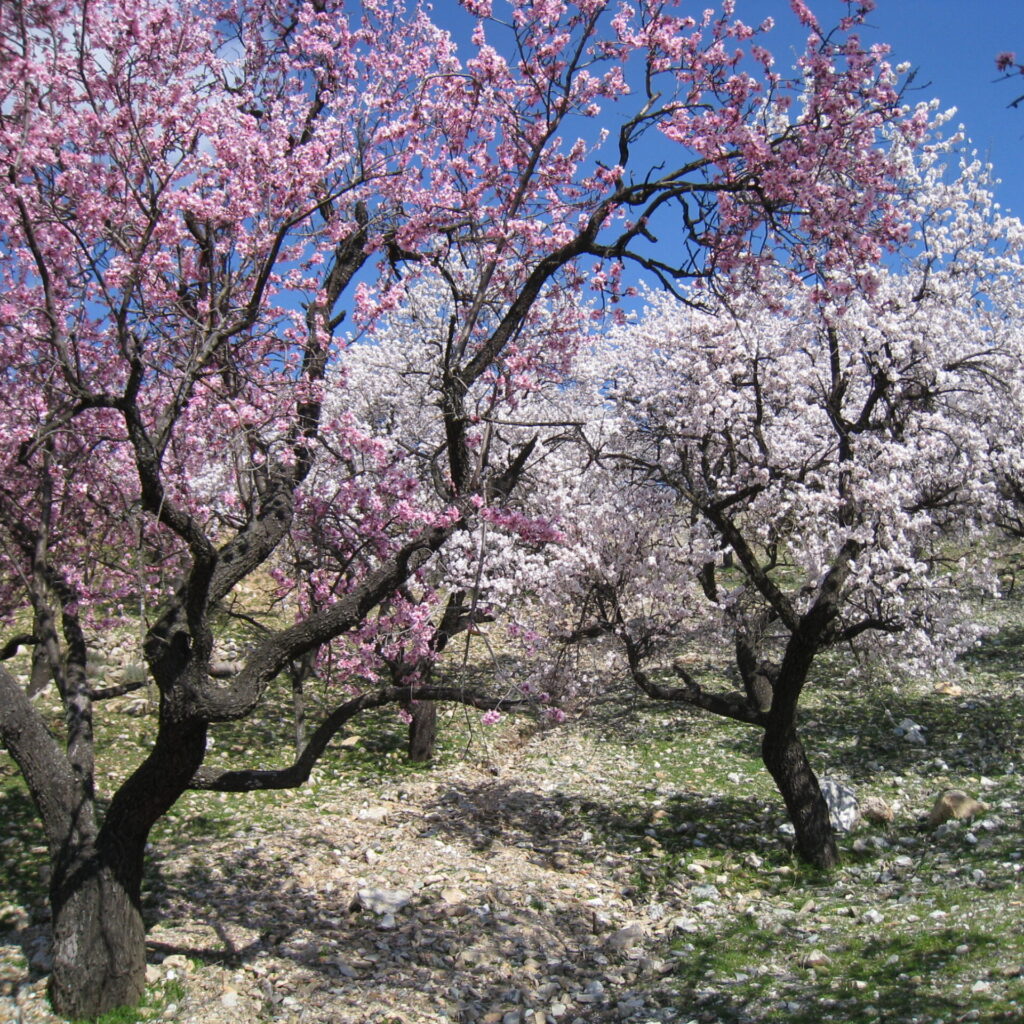
In late January, the Almond groves around my Andalucian home are awash with blossom, resembling frilly pink and white tutus dressing the stark, black, gnarled trunks. To me, the trees appear to be dancing on the hillside — and as if someone had suddenly called, “Stop!” — they are caught mid-dance in wild, graceful poses.
These wonderful trees seem deeply connected to winter and the element of water. They bloom during this season, and their summer fruits are often made into marzipan and turrón, foods traditionally eaten during the festive months. It’s a time when it’s easy to get swept up in busyness, overspending, overconsuming, or simply overextending ourselves. The dancing almond trees on the hillsides remind me that I can always find stillness within motion.
Today I made a journey to Almond once again. As I walk up the rocky path and breathe in the fragrance of the blossoms carried on the chill mountain air, my mind begins to quiet, and my body hums in response to the bees gathering their first nectar of the year. I find a sit spot, settle in, and as I soften into the landscape, thoughts drift through me. Though I feel the familiar urge to distract myself, I notice something happening in my spine — a current of energy flowing up and down, and a hollow space within my belly filling with warmth and peaceful no-thingness.
Breathing rhythmically with Almond, I sense an invitation to move into a deeper rhythm — a more authentic response to life than my usual reactions to the world around me. Almond helps me find stillness when chaos rages, and today, I am embodying Almond — finding that still point within.
I’m reminded of what Almond told me when our relationship began: that its essence interacts with craniosacral rhythms — our personal tides of ebb and flow. Curious, I spoke with a friend who is a craniosacral practitioner and tutor. She explained that the “mid-tide” is a 15-second cycle of ebb and flow that involves all the fluids in the body — the blood, lymph, and the fluid that bathes each cell. This rhythm takes us back to our embryonic blueprint, the original design for life. It seems possible that Almond may help us reset the body’s fight, flight, or freeze mechanism.
When we’re overly stressed, we often default to this mode — reacting to life rather than responding. We fill ourselves with external stimuli; food, work, stimulants, or distraction — rather than seeking that inner space of stillness, the fertile void from which authentic response arises.
The Greek name for Almond, Prunus amygdalus, connects to the amygdala — the almond-shaped part of the brain involved in processing fear. The amygdala governs the “fight or flight” response: increased heart rate, muscle tension, trembling, sweaty palms, even nausea. It is also the seat of fear conditioning where even a small trigger can evoke a full-blown reaction.
In a world filled with news of war, distress, and displacement, Almond seems to offer us an opportunity: to reconnect with our deep authentic rhythms, and to respond — not merely react — to life’s stimuli.
Almond was the first tree to teach me its song, one crisp, clear winter morning in a meadow high in the Contraviesa of the Alpujarras. Since then, it has become a key essence in many of the blends I create — a teacher of stillness, rhythm, and quiet strength.
Bugloss (Echium Vulgare) The Beloved Within
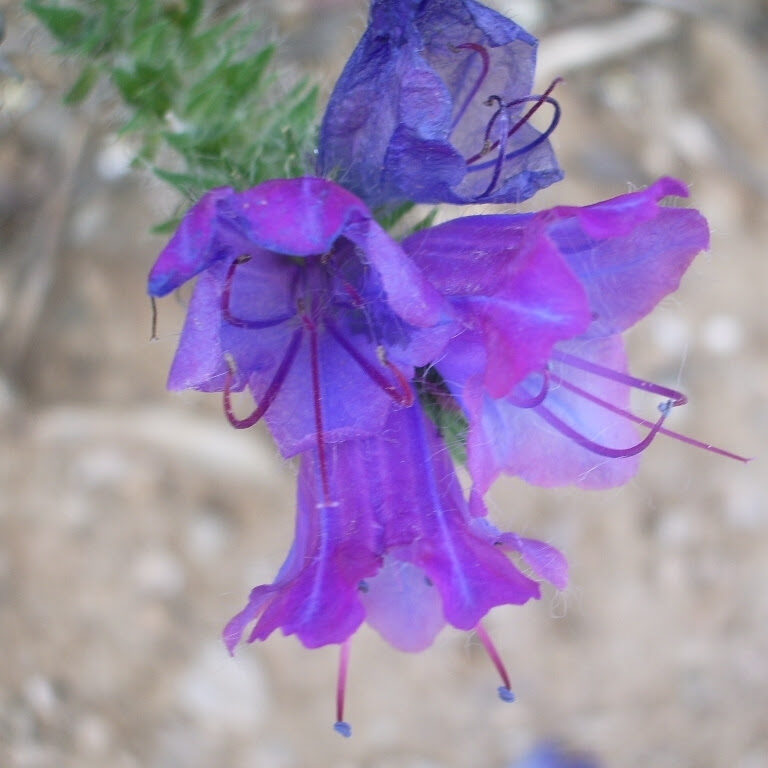
This essence was made in a meadow alive with Purple Bugloss. The Deva of Bugloss invited me to fall into the sea of violet-blue flowers stretching towards the horizon. As I sank into the meadow, I felt supported, held, and softly cradled by the Earth. My worries drifted away, and my attention turned inward, drawn gently towards what was stirring within my heart.
In that quiet, Bugloss spoke:
“The heart is pure, sacred, and divine. Our role; as Bugloss and as the Heart Protector is to help you meet the experiences of life so that your heart can fully open.
Sometimes the Heart Protector carries a heavy burden, for you hold so much guilt, resentment, sadness, regret and then you try to judge or justify it with your mind, which only deepens the pain.
We do not judge or make wrong. We serve the Heart. That which does not serve, we seek to heal.
The Heart is the dwelling place of Divine Love. Many of you search for love in the outer world, catching fleeting glimpses that you may spend a lifetime chasing, or seeing your own perceived lack reflected back to you.
When you allow us to help you move through your fears, pain, and feelings of loss, a spark of divine love is lit within your heart. We nurture this spark until it becomes a steady flame — a living fire of love within.
Then, when you look out at the world, you will see the Beloved Within reflected back to you.”
As I lay among the blossoms, I could feel that small but steady flame burning in the quiet centre of my chest. The scent of the meadow, the hum of bees, and the soft movement of air around me all seemed to echo the same truth: love begins within, and everything outside is simply its reflection.
Carob (Ceratonia siliqua) The Flow of Unconditional Love
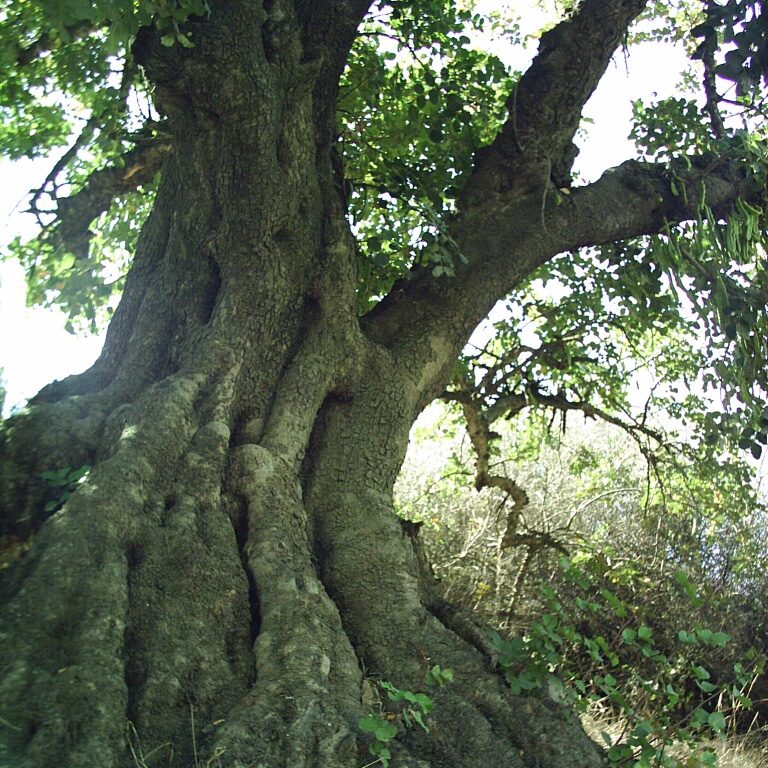
This wonderful tree offers welcome shade from the heat of the sun and nourishment from its fruit. It grows in rocky, inhospitable places, with little water or sustenance from the soil. Humans have shared a relationship with Carob for centuries. The Bible tells of John the Baptist surviving on its pods in the wilderness, and for this reason it is sometimes called St John’s Bread, or Café y chocolate.
Carob beans, while used as animal fodder, also provide a naturally sweet substitute for chocolate. They contain protein, carbohydrates, calcium, phosphorus, and several B vitamins — all part of Carob’s generous and nourishing signature.
The day I made this essence, I followed my usual method: placing the flowers in a bowl of spring water and sitting quietly in the shade of the tree. Suddenly I became acutely aware of an intense emotional pain — as though I could feel the sorrow of everyone who had ever felt not good enough or unloved.
As I sat and allowed the feelings to move through and out of me, a strong sensation arose — of being held and nurtured, as though in a loving mother’s arms. From this experience, the profile of Carob began to reveal itself:
For those who feel they were not adequately mothered, or who are needy of love and may have closed their hearts to avoid feeling pain. Carob enables us to find the “loving mother” archetype within, who can nourish the needy child.
When we feel isolated, desolate, alone, or unrecognised, we tend to act out habitual patterns of suppression to avoid uncomfortable feelings. In doing so, we can create distortions and patterns of dependency in our relationships — seeking love and acceptance outside ourselves to avoid our inner pain.
Yet if we find the courage to explore what lies beneath our fears and conditioned behaviours, we may discover that our true nature is love. From that recognition, we can begin to be love — healing heart wounds and creating relationships that are interdependent rather than dependent.
The wounded heart is the place where we feel most vulnerable, where we hold our personal story, our guilty secrets, loneliness, and shame. And yet, paradoxically, it is also the place of greatest potential for transformation. When we are able to unlock our aching hearts, we begin to express the divinity of who we truly are.
The paradox is that we cannot find this through another person. If we interact through the filter of fear, we create further co-dependency and confusion. But when we take the risk of opening our hearts and embracing our wounds, compassion naturally arises, and we become more authentic in our interactions. Love then flows through us, dissolving the illusions of fear. In that flow, individually and collectively, we rise into the current of unconditional love.
“You are unconditional love — this is your true heritage. It is only that you are caught in the illusions of fear and limitation which prevent you from diving into the flow of love that longs to move you and move through you.”
Carob Deva
During a workshop on Saturday, we connected with the land and the plants that are our neighbours; among them Fig, Eucalyptus, and Carob. As the session ended, I returned to sit quietly with the Carob tree. In just a few moments, my mood shifted completely. I went from feeling confident, serene, and connected, to feeling sad, awkward, isolated, and lonely. The mood stayed with me through the night and into the following day.
Fortunately, I am familiar with the many ways plants communicate with us, so I allowed the emotions to move in waves. Carob was showing me how essential the depth of our connections is — rather than the number of them.
I have learned that part of Carob’s signature is unconditional love and compassion — and the importance of including oneself within that circle of compassion. Otherwise, it becomes a subtle manipulation rather than true compassion.
Today Carob took me to a deeper level and spoke to me, among other things, about intimacy.
Into me see. Intimacy is a much-maligned word. When we speak of ‘intimate relationship’, sexual connection usually comes to mind. Yet when intimacy remains only physical, without deep heartfelt communication, we can feel bereft. Carob teaches that our hearts are longing for deep intimacy — with the land we live on, with the trees, and with one another.
We have forgotten how to express the language of love in all its forms, and are often afraid to let ourselves be truly seen. It takes courage, in this world of celebrity, soundbites, and spectacle, to remain authentic — to speak and act from where we truly are, whether in grief, loss, sadness, love, or joy.